
Definition of NRI
1) Who is a NRI?
An NRI (Non-Resident Indian) is an individual of Indian nationality or origin who resides outside India for employment, business, or other purposes that indicate their intention to stay outside India for an uncertain period. The definition and tax implications for NRIs are governed by the Income Tax Act of India.
2) Who is considered to be a NRI?
Under the Income Tax Act, the residential status of an individual is determined based on their physical presence in India during a financial year (April 1 to March 31). An individual is considered an NRI if they meet the following criteria:
Non-Resident:
- Has been in India for less than 182 days during the financial year, or
- Has been in India for less than 60 days during the financial year and less than 365 days during the preceding four years.
NRI Taxable Income & Taxation
1) What are the incomes which is Taxable and Not Taxable in India for NRIs?
a) Income Taxable in India:
- Income Received in India: Any income received or deemed to be received in India is taxable.
- Income Accrued in India: Any income that accrues or arises or is deemed to accrue or arise in India is taxable.
b) Income Not Taxable in India:
- Foreign Income: Any income earned and received outside India is not taxable for NRIs.
2) What are different types of Income & their Tax implications for NRIs?
- Salary Income: Taxable if received in India or for services rendered in India.
- Rental Income: Taxable in India if the property is situated in India. Standard deductions and exemptions apply as for resident taxpayers.
- Interest Income:
- NRE Account: Interest earned on a Non-Resident External (NRE) account is tax-free.
- FCNR Account: Interest earned on Foreign Currency Non-Resident (FCNR) accounts is tax-free.
- NRO Account: Interest earned on a Non-Resident Ordinary (NRO) account is fully taxable.
- Capital Gains:
- Sale of Assets in India: Gains from the sale of assets such as property, shares, and securities in India are taxable.
- Short-Term Capital Gains: Taxable at applicable rates based on the type of asset.
- Long-Term Capital Gains: Taxable at 20% with indexation benefit for property and other assets, and at 10% without indexation for equity and equity mutual funds.
- Dividends: Dividends received from Indian companies are taxable in the hands of the NRI at the applicable slab rates. The company paying the dividend withholds tax at source.
- Special Provisions for Investment Income: Income from investments made in India in certain specified assets is taxed at 20%, and long-term capital gains on these assets are taxed at 10%.
3) What is DTAA?
India has entered into DTAA (Double Taxation Avoidance Agreement) with various countries to avoid double taxation of income. NRIs can benefit from these treaties to reduce their tax liability in India and their country of residence. Provisions include:
- Tax Credit: Credit for taxes paid in one country against the tax liability in another.
- Exemptions and Lower Rates: Income may be exempt or taxed at a lower rate under the DTAA.
NRI Mutual Fund Related FAQs
1) Can NRIs invest in Mutual Funds (MFs)? Do they require any special permission from the RBI?
NRIs can invest in mutual funds on a repatriable as well as non-repatriable basis. They don’t require any special permission from RBI in this regard. RBI has, vide Notification No. FEMA 20/2000 dated May 3, 2000, granted general permission to NRIs to purchase, on a repatriation as well as non-repatriation basis, the units of domestic mutual funds.
2) Are there any specific procedures to be followed for making the investment on a repatriable / non-repatriable basis?
Investment on a Repatriable Basis
An NRI can invest in domestic mutual funds on a repatriable basis, provided the consideration is paid either by:
- Inward remittance through normal banking channels, viz.,
- Rupee drafts purchased abroad, or
- Out of funds held in NRE/FCNR account.
In case of Indian Rupee drafts purchased abroad or if investment is made from funds in NRE/FCNR account, a debit certificate from the issuing bank shall be required.
Investment on a Non-Repatriable Basis
An NRI can invest in domestic mutual funds on a non-repatriable basis, provided the consideration is paid either by inward remittance through normal banking channels or out of funds held in NRO/NRSR/NRNR accounts.
3) What is various Taxes for NRIs while investing into Mutual Funds?
Investing in mutual funds as an NRI involves specific tax implications in India. The tax treatment depends on the type of mutual fund (equity or debt) and the holding period.
Types of Mutual Funds
- Equity Mutual Funds: Funds that invest at least 65% of their corpus in equity and equity-related instruments.
- Debt Mutual Funds: Funds that invest primarily in fixed-income securities like bonds, government securities, and money market instruments.
- Hybrid Funds: Funds that invest in a mix of equity and debt instruments.
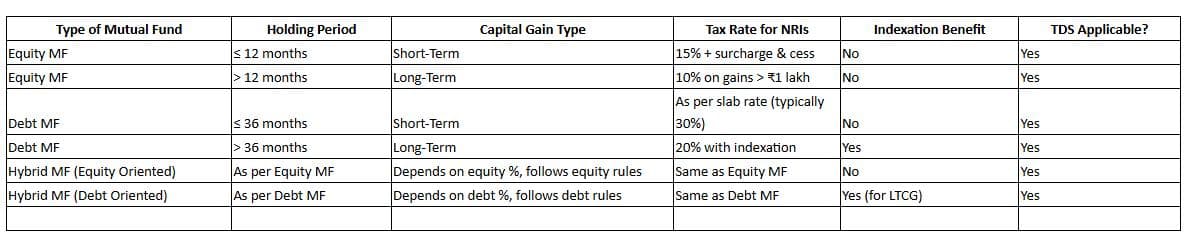
Investment options for NRIs
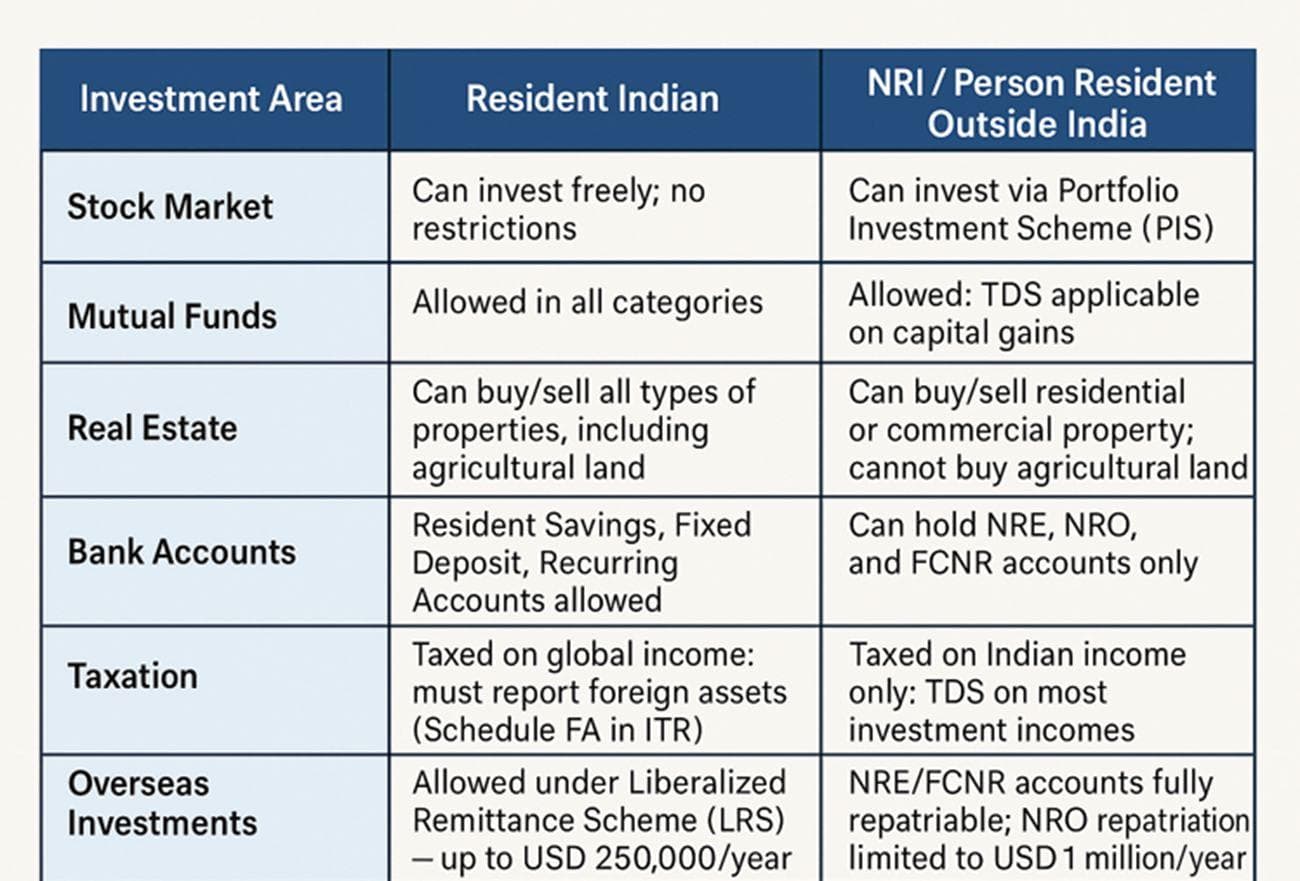
(Content can be detailed as per requirement.)
How are debt MFs better than NRE FDs for US NRIs

(Content can be detailed as per requirement.)
4) How can NRIs repatriate their Mutual Funds from India?
- Investments from NRE/FCNR Accounts: Both principal and gains are fully repatriable.
- Investments from NRO Account: Only the capital gains (not the principal) are repatriable, subject to applicable limits and conditions set by the Reserve Bank of India (RBI).
Bank Account Types, Regulations & Requirements
1) What are various types of bank accounts offered for NRIs?
NRIs have various options for maintaining bank accounts in India, each tailored to different needs such as savings, investment, repatriation, and everyday transactions.
1. NRE (Non-Resident External) Account
Purpose: To park overseas earnings in India in Indian Rupees.
- Currency: Maintained in Indian Rupees (INR).
- Repatriability: Both principal and interest are fully repatriable to the NRI's country of residence without restrictions.
- Taxation: Interest earned is tax-free in India.
- Deposits: From foreign income or transfers from another NRE/FCNR account.
- Withdrawals: Freely in INR for local expenses.
- Types: Savings, current, recurring deposit, and fixed deposit accounts.
2. NRO (Non-Resident Ordinary) Account
Purpose: To manage income earned in India such as rent, dividends, pension, etc.
- Currency: Maintained in Indian Rupees (INR).
- Repatriability: Principal amount is not repatriable beyond a set limit (currently up to USD 1 million per financial year), while interest is fully repatriable.
- Taxation: Interest earned is subject to TDS as per applicable slab rates.
- Deposits: Income earned in India or transfers from another NRO account.
- Withdrawals: Freely in INR for local expenses.
- Types: Savings, current, recurring deposit, and fixed deposit accounts.
3. FCNR (Foreign Currency Non-Resident) Account
Purpose: To maintain overseas earnings in foreign currency without converting to INR.
- Currency: Maintained in foreign currencies such as USD, GBP, EUR, JPY, AUD, CAD, etc.
- Repatriability: Principal and interest fully repatriable.
- Taxation: Interest earned is tax-free in India.
- Deposits: Overseas income or transfers from FCNR/NRE accounts.
- Withdrawals: In foreign currency.
- Types: Fixed deposit accounts only (terms range 1–2 years).
2) What are the documents required to Open various NRI Bank accounts?
- Proof of NRI Status: Passport, visa, and/or residence permit.
- Proof of Overseas Address: Utility bills, rental agreement, or overseas bank statement.
- Proof of Identity and Address in India: Aadhaar card, PAN card, etc.
- Recent passport-sized photographs.
3) What are the various Rules & Limits for Repatriation for NRIs?
NRIs often need to transfer money between India and their country of residence. The rules and regulations govern the repatriation of funds from India and ensure compliance with Indian laws.
1. NRE (Non-Resident External) Account
Purpose: To park overseas earnings in India.
- Repatriability: Both the principal and interest amounts are fully and freely repatriable. Funds can be transferred to a foreign account without any restrictions.
- Conditions: Deposits can be made from foreign earnings or by transferring from another NRE/FCNR account. There are no limits on the amount that can be repatriated.
2. NRO (Non-Resident Ordinary) Account
Purpose: To manage income earned in India such as rent, dividends, pension, etc.
- Repatriability: Interest earned is fully repatriable after paying applicable taxes. Principal repatriation is allowed up to USD 1 million per financial year (April to March), including all other eligible assets.
- Conditions: The account holder must submit appropriate documents, including Form 15CA and Form 15CB (signed by a Chartered Accountant) to certify that taxes have been paid. Prior approval from the Reserve Bank of India (RBI) is not required within the repatriation limit.
3. FCNR (Foreign Currency Non-Resident) Account
Purpose: To maintain overseas earnings in foreign currency without converting to INR.
- Repatriability: Both the principal and interest amounts are fully and freely repatriable. Funds can be transferred to a foreign account in the currency of the deposit.
- Conditions: Deposits can be made from foreign earnings or by transferring from another FCNR/NRE account. There are no limits on the amount that can be repatriated.
4) What are the documents required for Repatriation?
Below are some of the key documents required for repatriation:
- Form 15CA: A declaration of remittance submitted by the remitter.
- Form 15CB: A certificate from a Chartered Accountant confirming that applicable taxes have been paid or that the transaction is not taxable.
- Bank Forms: Specific forms provided by the bank for processing the repatriation request.
Checklist for Resident Indians (RIs) Moving Abroad and Becoming Non-Resident Indians (NRIs)
1. Banking & Financial Accounts
- Convert your resident savings accounts to Non-Resident External (NRE) or Non-Resident Ordinary (NRO) accounts.
- Consider opening a Foreign Currency Non-Resident (FCNR) deposit for foreign currency savings.
- Update KYC details with your bank, informing them of your NRI status.
- Close unnecessary resident savings accounts (NRIs cannot hold these).
2. Investments & Mutual Funds
- Update KYC status to NRI for all mutual fund holdings.
- Check with fund houses to see if they allow investments from your new country of residence (many AMCs restrict U.S. and Canada-based NRIs).
- Convert resident Demat & trading accounts to NRI Demat and Portfolio Investment Scheme (PIS) accounts if continuing to invest in Indian equities.
- Review tax implications on capital gains in both India and your new country of residence.
- Update bank mandate for dividend payouts to an NRO account.
3. Taxation & Compliance
- Check if you qualify as an NRI under FEMA (staying abroad for more than 182 days) and the Income Tax Act (considering previous financial years).
- File ITR as NRI from the next assessment year.
- Understand the Double Taxation Avoidance Agreement (DTAA) between India and your new country to avoid double taxation.
- If maintaining property in India, note TDS rules on rental income (30% TDS applicable).
- Ensure the correct Tax Residency Certificate (TRC) is obtained to claim DTAA benefits.
4. Property & Real Estate
- NRIs can continue to hold residential and commercial properties in India.
- If selling property, TDS deduction applies (20% on long-term capital gains for NRIs).
- Update property documents with your NRI status for smooth future transactions.
5. Insurance & Loans
- Convert life and health insurance policies to NRI status (check premium payment options).
- Review existing loans—NRI status can impact eligibility and terms of home loans, personal loans, etc.
- Check RBI regulations for repayment of loans as an NRI.
6. PAN & Aadhaar Updates
- Ensure your PAN is linked with Aadhaar (compulsory for tax filing).
- Update your address and contact details linked to PAN and Aadhaar.
- NRIs are not required to hold Aadhaar unless filing tax returns in India.
7. Remittances & Repatriation
- Use NRE accounts for easy repatriation of income earned abroad.
- Keep track of foreign remittance limits and reporting requirements under FEMA.
- Understand repatriation rules for sale proceeds of property, investments, and rental income.
- Under the Liberalized Remittance Scheme (LRS), resident Indians can remit up to USD 250,000 per financial year for permissible capital and current account transactions.
8. Estate & Will Planning
- Update nominee details for bank accounts, mutual funds, insurance, and Demat accounts.
- Consider making a Will to avoid complications in India regarding inheritance laws.
- If holding assets in India and abroad, consult a financial planner for estate planning.
9. Compliance for Returning NRIs (RNOR & Tax Status)
- If planning to return, understand Returning NRI (RNOR) status for tax exemptions.
- Plan for reinvestment of foreign income/assets upon return to India.
- Convert NRE/NRO accounts back to resident accounts when returning.

Top 5 Benefits of RNOR Status for Returning NRIs
If you're an NRI planning to return to India, timing your return smartly can help you qualify as RNOR and save taxes. Let's understand the key benefits of the RNOR status.
1. Extended RNOR Status with Smart Timing
RNOR status depends on when you return to India. For example:
- Return in July 2025 → RNOR for 2 years (FY 25–26 & 26–27).
- Return in March 2026 → You are still NRI for FY 25–26, so you can claim RNOR for 3 years (FY 25–26, 26–27, 27–28).
2. Tax Advantage on Global Income
- ROR (Resident & Ordinarily Resident): Taxed on worldwide income.
- RNOR: Only Indian income is taxable.
This allows you to receive foreign income tax-free in India during RNOR years.
3. Lower Tax on Indian Investments
RNOR enjoys regular resident tax slabs, unlike NRIs who are often taxed at the highest rate on FD interest.
4. Wider Investment Options
RNORs can invest in:
- PPF (Public Provident Fund)
- Senior Citizen Savings Scheme
- Agricultural land (which NRIs cannot purchase)
5. RFC Account Benefits
RNORs can open and use RFC (Resident Foreign Currency) accounts. Interest on RFC accounts is tax-free as long as you remain an RNOR.
NRI Sale of Property & Other Asset Class Related FAQs
1) How do NRIs repatriate funds through Sale of Property?
- Residential Properties: NRIs can repatriate the sale proceeds of up to two residential properties.
- Commercial Properties: There are no specific limits, but repatriation is subject to overall repatriation limits and tax compliance.
- Conditions: Proceeds must be credited to an NRO account, and repatriation is subject to the USD 1 million limit per financial year. Taxes must be paid, and documentation (such as proof of purchase, sale, and tax payment) must be provided.
2) What are the issues with Real Estate for NRIs?
Buying multiple properties in India is not efficient from the taxation perspective. Only one property can be shown as self-occupied. The other has to be rented out, and rental income is taxable; if not rented out, it is considered deemed let-out, and the deemed rent is taxable. Investors not showing rental income from multiple properties becomes an issue with Indian tax compliance.
Tracking of properties held by Indian residents and NRIs is difficult and, hence, real estate investors have always been flying under the radar of tax authorities. NRIs/PIOs/ OCIs are big investors in Indian real estate; they have to worry whether FATCA will apply to real estate holdings in future. The issue, again, is that income from real estate may not have been reported in the US tax returns and, hence, NRIs may not want to reveal that they did not report the Indian rental income in US tax returns. With fear of FATCA, NRIs are trying to come clean before they get caught.
Property Buying Fraught with Unclear Title Issues
Real estate has been a popular investment option for NRIs/PIOs/OCIs. They are allowed to invest in residential and commercial properties with NRO/NRE accounts to make payments but cannot invest in agricultural land, farmhouses, or plantations in India. NRIs can own such properties only if they have been inherited, but they can sell such properties only to a resident Indian.
With the real estate market in India going through a downturn, NRIs should be wary of buying property as an investment. Moreover, buying property in India can have issues of legalities and clear titles. It is crucial to ensure the property has all the required approvals from civic authorities for construction. Having the right intermediary can help to check documentation and do proper title search and transfer.
NRIs can avail home loans from Indian banks or financial institutions after satisfying eligibility criteria. The loan amount and repayment transactions are in Indian rupees.
Property Selling Can Trouble You with Capital Gains Abroad
Property is an illiquid asset. It is not easy to sell in a down market without taking a beating. Selling property comes with some restrictions by FEMA (Foreign Exchange Management Act), especially for repatriation transactions. The property transaction can generate a high amount of capital gains which can create taxation issues, depending on the country of residence.
Taxation on capital gains in India can be avoided by buying another property or investing in capital gains savings bonds (REC/NHAI). But your country of residence may not accept such an arrangement, and may still tax the capital gains without allowing indexation or such exemptions. Hence, it is crucial to consider if the income-tax liability in the country of residence will nullify the tax savings you made to satisfy Indian tax laws.
Buying property in India may seem unattractive when you consider the tax angle in your country of residence. So, don’t jump into buying property without knowing the tax issues when you exit.
3) Property on Rent – Is Tax Deducted at Source?
Renting your property with a ‘leave and licence’ (L&L) agreement can be better than giving your property without any paperwork. Registering and paying stamp duty on the L&L agreement can ensure your right as the owner.
Power of Attorney (PoA): As an NRI, you may need to give PoA to a family member to execute the L&L agreement in your absence. There is always the fear of the licensee not vacating the property despite signing an L&L agreement.
TDS on Rent: Under an L&L agreement, the licensee is required to deduct tax at source at 30.9% under Section 195 before making the balance rental payment to the NRI owner and pay the rent directly into the NRO account. The owner may claim a refund if the overall income is below the taxable limit.
4) How do NRIs repatriate funds through Sale of Shares and Securities?
- Repatriability: NRIs can repatriate sale proceeds after paying applicable taxes.
- Conditions: Investments must be made on a repatriable basis (through NRE/FCNR accounts). The transaction should be routed through a registered stockbroker.
Portfolio Investment Scheme (PIS)
1) What is PIS (Portfolio Investment Scheme)?
The Reserve Bank of India (RBI) allows NRIs and overseas citizens of India (OCI) / persons of Indian origin (PIOs) to invest in the Indian equity markets under PIS (Portfolio Investment Scheme). PIS is a foreign investment route to simplify the process of registration and investment.
NRIs/OCIs/PIOs can purchase or sell shares/NCDs (non-convertible debentures) of Indian companies on the stock exchange by:
- Opening an NRE or NRO bank account and obtaining approval for stock trading under PIS.
- Opening a trading account (linked to the PIS account) and demat account with a broker/service provider.
Many banks offer all these services at a single point, making the process smooth. Important points:
- Only one PIS account can be opened for buying and selling of shares.
- Stock investment cannot exceed 10% of the paid-up capital of the company.
- Intraday trading not allowed; NRIs must take delivery of shares.
- Short-selling is not allowed.
- Can invest only in selected stocks as listed by RBI periodically.
- Investment can be done on repatriation as well as non-repatriation basis.
The following transactions do not need a PIS account:
- Sale of shares which were not bought under PIS (e.g., gifts, IPO subscription, bonus shares, or shares bought as a resident Indian).
- Fresh subscription for IPOs as an NRI.
- Investment in mutual funds.
An NRI is eligible to subscribe to mutual funds and bonds in India, provided the issuer has enabled the ‘NRI window’ in the offer. Bonds can be tax-free or taxable and can be subscribed on both repatriable and non-repatriable basis via NRE/NRO accounts.
Exchange Traded Funds (ETFs) can also be purchased through the PIS-linked NRE/NRO accounts. However, US-based NRIs may want to avoid certain ETFs or PFIC-classified entities due to US tax rules.
Direct vs Regular Mutual Funds
1) What is the impact on returns with respect to Direct & Regular Mutual Funds?
When investing in mutual funds, NRIs and resident investors can choose between direct plans and regular plans. The choice between these can significantly impact returns.
Direct Plans
Direct plans are mutual fund schemes where investors invest directly with the fund house without intermediaries.
- No distributor commission.
- Lower expense ratio.
- Higher NAV.
- Higher potential returns.
- DIY approach and no advisory services.
Regular Plans
Regular plans are mutual fund schemes where investors invest through intermediaries such as brokers, agents, or distributors.
- Includes distributor commission.
- Higher expense ratio.
- Lower NAV.
- Professional advice and convenience.
Impact on Returns – Example
Assume an investment of ₹1,00,000 in both direct and regular plans of the same fund.
- Gross return: 10% (₹10,000)
- Direct plan expense ratio: 1.0%
- Regular plan expense ratio: 1.75%
Over time, the difference in expense ratio compounds, leading to significantly higher returns in direct plans compared to regular plans.
Strategy used for Mutual Fund Investment & Return Expectations
Checklist for NRIs Returning to India
1. Banking & Financial Accounts
- Convert NRE/NRO accounts back to resident savings accounts.
- Close any unnecessary NRE/NRO accounts as per RBI guidelines.
- Consider opening a Resident Foreign Currency (RFC) account to park foreign earnings in India.
- Update KYC details in all Indian bank accounts with your new residential status.
2. Investments & Mutual Funds
- Convert NRI Demat & trading accounts back to resident status.
- Update KYC details with mutual fund houses to reflect resident status.
- Reassess investments and modify portfolio allocation based on Indian tax laws.
- Check LTCG tax implications on overseas investments and repatriation of proceeds.
- Under RBI's LRS, returning NRIs can remit up to USD 250,000 per financial year.
3. Taxation & Compliance
- Understand RNOR status and tax benefits for the transition period.
- RNOR status can apply for up to two years post-return and offers tax exemptions on foreign income.
- Income earned outside India is not taxable in India during the RNOR period, except if received in India.
- Update PAN details with the new residential status.
- File ITR as a resident Indian for the next assessment year.
- Declare all foreign assets and income in tax filings.
- Check applicability of DTAA for foreign income.
- Obtain a Tax Residency Certificate (TRC) if required.
4. Property & Real Estate
- Update home address in property documents, utility bills, and Aadhaar.
- Check capital gains tax liability if selling property abroad before moving back.
- Consider repatriating proceeds from property sales under FEMA guidelines and your country-of-residence tax rules.
5. Insurance & Loans
- Update life and health insurance policies with your new residential status.
- Convert existing international health insurance to an Indian equivalent if required.
- Reassess home loans, personal loans, and credit card payments in both countries.
6. PAN & Aadhaar Updates
- Ensure your PAN is linked with Aadhaar for tax compliance.
- Update address and contact details linked to PAN and Aadhaar.
- Apply for Aadhaar if not previously obtained, as it may be required for banking and taxation.
7. Foreign Assets & Repatriation
- Plan repatriation of foreign earnings through legal channels.
- Understand FEMA limits for remittance and reporting requirements.
- Consult a financial planner for tax-efficient transfer of significant overseas assets.
- Close unnecessary foreign bank accounts if no longer needed.
8. Estate & Will Planning
- Update nominee details for bank accounts, investments, and insurance policies.
- Modify or create a new Will reflecting your change in residency and asset locations.
- Ensure compliance with Indian succession laws for foreign assets where applicable.
9. Employment & Business Transition
- Inform employer and update tax withholding details if returning permanently.
- If self-employed or owning an overseas business, assess tax and legal implications.
- Transfer professional credentials/licenses to India if required for work.
10. Social Security & Retirement Planning
- Check eligibility for pension withdrawals or transfers from overseas funds.
- Understand social security benefits (e.g., US Social Security) and whether you can claim them in India.
- Plan for retirement savings in India by investing in schemes like EPF, PPF, or NPS.
11. Family & Education Considerations
- If moving with children, review school/university admission procedures in India.
- Ensure all family members have updated documents (passports, Aadhaar, PAN, etc.).
- Plan healthcare and insurance needs for dependents.
1) Which Mode of investing is suggested for NRIs – SIPs or STPs?
Systematic Transfer Plans (STPs) allow investors to transfer a fixed amount at regular intervals from one mutual fund to another, typically from a debt fund to an equity fund. For NRIs, STPs offer strategic benefits but also specific tax implications.
Benefits of STPs for NRIs
- Rupee Cost Averaging: Helps average out the purchase cost and reduce the impact of volatility.
- Consistent Investment: Ensures disciplined, regular investing without timing the market.
Considerations for NRIs Using STPs
1) Tax Deducted at Source (TDS):
- For NRIs, mutual fund houses deduct TDS on capital gains.
- Debt funds: TDS at 30% on STCG and 20% on LTCG.
- Equity funds: TDS at 15% on STCG and 10% on LTCG (on gains exceeding ₹1 lakh).
If the investor is not comfortable with TDS on each transfer, they can keep a lump sum in a savings account and do weekly SIPs instead of STPs. The trade-off is lower potential returns compared to liquid or arbitrage funds, which typically offer around 5%–8% p.a., while savings accounts offer around 3%–4% p.a.
2) What are the return expectations for various risk profiles?
Based on risk profile, approximate return expectations are:
- Very Conservative Risk Profile: 7% – 9%
- Conservative Risk Profile: 8% – 10%
- Moderate / Balanced Risk Profile: 9% – 12%
- Aggressive Risk Profile: 10% – 13%
- Very Aggressive Risk Profile: 14% – 18%